Monday, 21 June 2010

The Unbearable Lightness of Being


Title: The Unbearable Lightness of Being

Author: Milan Kundera

Number of pages: 305

Started: 17 June 2010

Finished: 21 June 2010

Opening words:

The idea of eternal return is a mysterious one, and Nietzsche has often perplexed other philosophers with it: to think that every¬thing recurs as we once experienced it, and that the recurrence it¬self recurs ad infinitum! What does this mad myth signify?

Putting it negatively, the myth of eternal return states that a life which disappears once and for all, which does not return, is like a shadow, without weight, dead in advance, and whether it was horrible, beautiful, or sublime, its horror, sublimity, and beauty mean nothing. We need take no more note of it than of a war be¬tween two African kingdoms in the fourteenth century, a war that altered nothing in the destiny of the world, even if a hundred thousand blacks perished in excruciating torment.

Will the war between the two African kingdoms in the four¬teenth century itself be altered if it recurs again and again, in eternal return?

It will: it will become a solid mass, permanently protuberant, its inanity irreparable.

If the French Revolution were to recur eternally, French his¬torians would be less proud of Robespierre. But because they deal with something that will not return, the bloody years of the Revolu¬tion have turned into mere words, theories, and discussions, have become lighter than feathers, frightening no one. There is an in¬finite difference between a Robespierre who occurs only once in his¬tory and a Robespierre who eternally returns, chopping off French heads.

Let us therefore agree that the idea of eternal return im¬plies a perspective from which things appear other than as we know them: they appear without the mitigating circumstance of their transitory nature. This mitigating circumstance prevents us from coming to a verdict. For how can we condemn something that is ephemeral, in transit? In the sunset of dissolution, everything is illuminated by the aura of nostalgia, even the guillotine.


Plot summary:

A young woman in love with a man torn between his love for her and his incorrigible womanizing one of his mistresses and her humbly faithful lover--these are the two couples whose story is told in this masterful novel. In a world in which lives are shaped by irrevocable choices and by fortuitous events, a world in which everything occurs but once, existence seems to lose its substance, its weight. Hence, we feel "the unbearable lightness of being" not only as the consequence of our private actions, but also in the public sphere, and the two inevitably intertwine.

What I thought:

Hmm, what did I make of this book. In some ways, it was a bit like War and Peace meets Paulo Coelho. This is probably not the strongest recommendation. The War and Peace bit because the way The Unbearable Lightness was written in places reminded me of it – things about coincidence and whether people are really in charge of their own destiny. It was also a sort of philosophical book – and I thought some of the philosophy was somewhat questionable and made assertions that if you thought about it for a few moments you would realise was completely based on flawed thinking.

The book was readable though and I feel as though I have read another of those books that people talk about and nod profoundly when it is mentioned. But I don’t really think that it lives up to its reputation.

Wednesday, 16 June 2010

The Story of Lucy Gault


Title: The Story of Lucy Gault

Author: William Trevor

Number of pages: 228

Started: 14 June 2010

Finished: 16 June 2010

Opening words:

Captain Everard Gault wounded the boy in the right shoulder on the night of June the twenty-first, nineteen twenty-one. Aiming above the trespassers' heads in the darkness, he fired the single shot from an upstairs window and then watched the three figures scuttling off, the wounded one assisted by his companions.

Plot summary:
Summer, 1921. Eight-year-old Lucy Gault clings to the glens and woods above Lahardane - the home her family is being forced to abandon. She knows the Gaults, as Protestants, are no longer welcome in Ireland and that danger threatens. She is headstrong and decides that somehow she must force her parents into staying. But the path she chooses ends in disaster.
One chance event, unwanted and unexpected, will blight the lives of the Gaults for years to come and bind each of them in different ways to this one moment in time forever. Trevor's novel, shortlisted for both the Booker and Whitbread Prizes, beautifully evokes rural Ireland and the tensions existing there, but also delicately portrays the terrible impact of mere chance on our lives.

See an interesting book group discussion on the book here.

What I thought:

I am not really sure about this book. It was well written and the words flowed off the page. It was a book that also had an underlying sadness to it and (without revealing the major part of the plot) you really wanted the situation to get resolved because things could have been so different if it wasn’t for a few actions that came together.

I thought the characters, particularly Lucy Gault, perhaps lacked a bit of depth and that the book would have been enhanced by a bit more reflection on how she felt about and dealt with things. But it was a readable book and I would be interested in reading another of William Trevor’s books.

Monday, 14 June 2010

The Moonstone


Title: The Moonstone

Author: Wilkie Collins

Number of pages:

Started: 30 May 2010

Finished: 12 June 2010

Opening words:

Extracted from a Family Paper

I address these lines — written in India — to my relatives in England.

My object is to explain the motive which has induced me to refuse the right hand of friendship to my cousin, John Herncastle. The reserve which I have hitherto maintained in this matter has been misinterpreted by members of my family whose good opinion I cannot consent to forfeit. I request them to suspend their decision until they have read my narrative. And I declare, on my word of honour, that what I am now about to write is, strictly and literally, the truth.

The private difference between my cousin and me took its rise in a great public event in which we were both concerned—the storming of Seringapatam, under General Baird, on the 4th of May, 1799.

In order that the circumstances may be clearly understood, I must revert for a moment to the period before the assault, and to the stories current in our camp of the treasure in jewels and gold stored up in the Palace of Seringapatam.


Read the book here or get it sent to you in 283 parts here.

Plot summary:

On her eighteenth birthday, beautiful Rachel Verinder receives a present like no other—an enormous, glittering, diamond. Little does she know that this legendary stone will bring with it a world of mystery and danger. Snatched from a sacred statue in India, the diamond is the subject of an intense worldwide search by priests whose ultimate duty is to find and restore the stone to its rightful place. The stone seems to hold strange powers beyond mere beauty, perhaps even a curse that travels with it. The sparkling Moonstone belongs to Rachel for one night only before it is stolen in the night, but a storm of grief, misfortune, and even madness follow in its wake. Who has taken the precious gem? Can the stone be found and returned to its rightful owners in time to stop the mysterious forces that threaten to tear apart Rachel's life and happiness?

What I thought:

When I first opened this book, one of the first things I read was a reference to Robinson Crusoe (it’s referred to at the start of the first chapter, which is after the prologue above). So I decided to put down this book and read Robinson Crusoe first. I like the interconnectedness of books and I often find themes echoed in entirely different styles of books or things or other books referred to. I like to keep an eye out for such things because it is interesting to see how books and ideas are so often linked.

Anyway, I put off reading The Moonstone to read Robinson Crusoe, a book I did not much enjoy. The Moonstone seemed to start a bit slowly, mainly because I was not the biggest fan of the initial narrator, who himself was a big fan of Robinson Crusoe. However, as the story unfolded, I found the book to be much better and more engaging than I had first thought. There were passages that kept me totally engaged and many a stop passed on the tube (where I do most of my reading) without me even being aware of them.

It was a great read, despite what seemed to me to be an unpromising start. I have mixed feelings about Wilkie Collins books – I loved The Woman in White but loathed Armadale. Despite my nervousness at reading this book, it came up trumps and has restored my faith in the author – who I am sure will rest much easier as a result…

Saturday, 29 May 2010

She


Title: She

Author: H Rider Haggard

Number of pages: 384

Started: 22 May 2010

Finished: 29 May 2010

Opening words:

In giving to the world the record of what, looked at as an adventure only, is I suppose one of the most wonderful and mysterious experiences ever undergone by mortal men, I feel it incumbent on me to explain what my exact connection with it is. And so I may as well say at once that I am not the narrator but only the editor of this extraordinary history, and then go on to tell how it found its way into my hands.

Some years ago I, the editor, was stopping with a friend, "vir doctissimus et amicus neus," at a certain University, which for the purposes of this history we will call Cambridge, and was one day much struck with the appearance of two persons whom I saw going arm-in-arm down the street. One of these gentlemen was I think, without exception, the handsomest young fellow I have ever seen. He was very tall, very broad, and had a look of power and a grace of bearing that seemed as native to him as it is to a wild stag. In addition his face was almost without flaw--a good face as well as a beautiful one, and when he lifted his hat, which he did just then to a passing lady, I saw that his head was covered with little golden curls growing close to the scalp.


Read more here.

Plot summary:

On his twenty-fifth birthday, Leo Vincey opens the silver casket that his father has left to him. It contains a letter recounting the legend of a white sorceress who rules an African tribe and of his father’s quest to find this remote race. To find out for himself if the story is true, Leo and his companions set sail for Zanzibar. There, he is brought face to face with Ayesha, She-who-must-be-obeyed: dictator, femme fatale, tyrant and beauty. She has been waiting for centuries for the true descendant of Kallikrates, her murdered lover, to arrive, and arrive he does – in an unexpected form. Blending breathtaking adventure with a brooding sense of mystery and menace, She is a story of romance, exploration discovery and heroism that has lost none of its power to enthral.

What I thought:

I had high hopes of this book. I read, and loved, King Solomon’s Mines and was hopeful that this book would be in the same league. Sadly, it did not live up to expectations. The opening chapters of the book were really good and set the scene really well, drawing the reader in to the unfolding mystery. But the rest of the book was not of quite the same standard and was written in what was, to a modern reader, quite stilted language.

I was not overly enamoured with the book and didn’t enjoy it anywhere near as much as I might have hoped. It had a lot of promise, but I felt the delivery did not quite live up to it. Do read King Solomon’s Mines though, as that is a really great read.

Friday, 21 May 2010

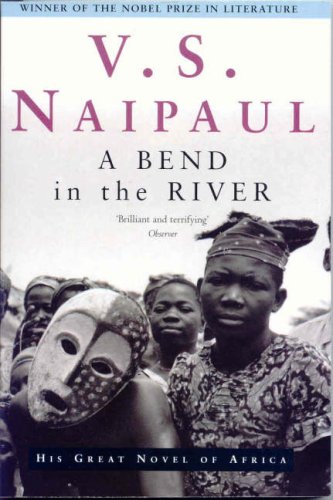
A Bend in the River


Title: A Bend in the River

Author: V.S. Naipaul

Number of pages: 336

Started: 14 May 2010

Finished: 21 May 2010

Opening words:

The world is what it is; men who are nothing, who allow themselves to become nothing, have no place in it.

Plot summary:

Salim, the narrator, is a young man from an Indian family of traders long resident on the coast of Central Africa. Salim has left the coast to make his way in the interior, there to take on a small trading shop of this and that, sundries, sold to the natives. The place is "a bend in the river"; it is Africa. The time is post-colonial, the time of Independence. The Europeans have withdrawn or been forced to withdraw and the scene is one of chaos, violent change, warring tribes, ignorance, isolation, poverty and a lack of preparation for the modern world they have entered, or partially assumed as a sort of decoration. It is a story of historical upheaval and social breakdown. Naipaul has fashioned a work of intense imaginative force. It is a haunting creation, rich with incident and human bafflement, played out in an immense detail of landscape rendered with a poignant brilliance.

What I thought:

This book had moments of brilliance and some really beautiful writing at times. But at other times, I found it dragged and didn’t really flow.

It was a decent enough read, and by a Nobel Prize Winner no less, but I found that the book didn’t consistently draw me in in the way that I hoped it would. But it was a well written and decently plotted book and there were pats of it that were to be savoured. But as a book as a whole, I found that it didn’t quite work for me.

Thursday, 13 May 2010

Fear the worst


Title: Fear the Worst

Author: Linwood Barclay

Number of pages: 368

Started: 7 April 2010

Finished: 13 April 2010

Opening words:

The morning of the day I lost her, my daughter asked me to scramble her some eggs. “Want bacon with it?" I shouted upstairs, where she was still getting ready for work.

To find out if she wants bacon and to read more here
Plot summary:

The worst day of Tim Blake's life started out with him making breakfast for his seventeen-year-old daughter Sydney. Syd was staying with him while she worked a summer job - even if he wasn't entirely sure what her job at the Just Inn Time motel actually was - and Tim hoped this quality father-daughter time would somehow help her deal with his divorce. When she didn't arrive home at her usual time, he thought she'd probably gone to the mall to hang with her friends. When she didn't answer her phone he began to worry. When she didn't come home at all, he began to panic. And when the people at the Just Inn Time said they had no Sydney Blake working at the motel and never had, he began to see his life going into freefall. If she hadn't been working at the Just Inn Time every day, what had she been doing? Something she couldn't - or wouldn't - tell her own father about? To find his daughter Tim doesn't need to simply track her down - he needs to know who she really was, and what could have made her step out of her own life without leaving a trace. Only one thing has him convinced the worst hasn't already happened: the fact that some very scary people seem just as eager as he is to find her. The question is: who's going to find her first?

What I thought:

This was a decent thriller. It was a fairly fast moving read, with a few twists that were possible to foresee, but mainly one that encouraged you to keep turning the pages. I don’t really tend to read crime novels anymore, but Linwood Barclay’s books are quite light reads and ones that are a decent distraction from some novels that are perhaps more hard work to plough through. It was also good to have a book that wasn’t entirely sewn up in some warm and fussy happy ending.

Thursday, 6 May 2010

Robinson Crusoe


Title: Robinson Crusoe

Author: Daniel Defoe

Number of pages: 252

Started: 29 April 2010

Finished: 6 May 2010

Opening words:

I was born in the year 1632, in the city of York, of a good family, though not of that country, my father being a foreigner of Bremen, who settled first at Hull. He got a good estate by merchandise, and leaving off his trade, lived afterwards at York, from whence he had married my mother, whose relations were named Robinson, a very good family in that country, and from whom I was called Robinson Kreutznaer; but, by the usual corruption of words in England, we are now called - nay we call ourselves and write our name - Crusoe; and so my companions always called me.

I had two elder brothers, one of whom was lieutenant-colonel to an English regiment of foot in Flanders, formerly commanded by the famous Colonel Lockhart, and was killed at the battle near Dunkirk against the Spaniards. What became of my second brother I never knew, any more than my father or mother knew what became of me.

Being the third son of the family and not bred to any trade, my head began to be filled very early with rambling thoughts. My father, who was very ancient, had given me a competent share of learning, as far as house-education and a country free school generally go, and designed me for the law; but I would be satisfied with nothing but going to sea; and my inclination to this led me so strongly against the will, nay, the commands of my father, and against all the entreaties and persuasions of my mother and other friends, that there seemed to be something fatal in that propensity of nature, tending directly to the life of misery which was to befall me.


Plot summary:

The sole survivor of a shipwreck, Robinson Crusoe is washed up on a desert island. In his journal he chronicles his daily battle to stay alive, as he conquers isolation, fashions shelter and clothes, first encounters another human being and fights off cannibals and mutineers. With Robinson Crusoe, Defoe wrote what is regarded as the first English novel, and created one of the most popular and enduring myths in literature. Written in an age of exploration and enterprise, it has been variously interpreted as an embodiment of British imperialist values, as a portrayal of ‘natural man’, or as a moral fable. But above all it is a brilliant narrative, depicting Crusoe’s transformation from terrified survivor to self-sufficient master of his island.

What I thought:

This was a strange, but enjoyable, book. It was not the most straightforward read and one that took a bit of time to get used to some of the language, but once I did I found that I enjoyed the tale. At times it went into more detail than was perhaps necessary to describe some of Crusoe’s life on his desert island, but the story warmed up as the tale unfolded.

It was an interesting take on the castaway story, and presumably one of the first, and strangely it did not ever really focus on the sense of being alone and how that affected Crusoe. It did bring in his reflections on life and God and other such things, which might not sit entirely well with some modern readers, including the rather imperialist role that he takes on ruling over all those he comes into contact with. But it’s a good read and given that it is thought to be one of the first novels, one that I am glad I have read.