Saturday, 29 May 2010

She


Title: She

Author: H Rider Haggard

Number of pages: 384

Started: 22 May 2010

Finished: 29 May 2010

Opening words:

In giving to the world the record of what, looked at as an adventure only, is I suppose one of the most wonderful and mysterious experiences ever undergone by mortal men, I feel it incumbent on me to explain what my exact connection with it is. And so I may as well say at once that I am not the narrator but only the editor of this extraordinary history, and then go on to tell how it found its way into my hands.

Some years ago I, the editor, was stopping with a friend, "vir doctissimus et amicus neus," at a certain University, which for the purposes of this history we will call Cambridge, and was one day much struck with the appearance of two persons whom I saw going arm-in-arm down the street. One of these gentlemen was I think, without exception, the handsomest young fellow I have ever seen. He was very tall, very broad, and had a look of power and a grace of bearing that seemed as native to him as it is to a wild stag. In addition his face was almost without flaw--a good face as well as a beautiful one, and when he lifted his hat, which he did just then to a passing lady, I saw that his head was covered with little golden curls growing close to the scalp.


Read more here.

Plot summary:

On his twenty-fifth birthday, Leo Vincey opens the silver casket that his father has left to him. It contains a letter recounting the legend of a white sorceress who rules an African tribe and of his father’s quest to find this remote race. To find out for himself if the story is true, Leo and his companions set sail for Zanzibar. There, he is brought face to face with Ayesha, She-who-must-be-obeyed: dictator, femme fatale, tyrant and beauty. She has been waiting for centuries for the true descendant of Kallikrates, her murdered lover, to arrive, and arrive he does – in an unexpected form. Blending breathtaking adventure with a brooding sense of mystery and menace, She is a story of romance, exploration discovery and heroism that has lost none of its power to enthral.

What I thought:

I had high hopes of this book. I read, and loved, King Solomon’s Mines and was hopeful that this book would be in the same league. Sadly, it did not live up to expectations. The opening chapters of the book were really good and set the scene really well, drawing the reader in to the unfolding mystery. But the rest of the book was not of quite the same standard and was written in what was, to a modern reader, quite stilted language.

I was not overly enamoured with the book and didn’t enjoy it anywhere near as much as I might have hoped. It had a lot of promise, but I felt the delivery did not quite live up to it. Do read King Solomon’s Mines though, as that is a really great read.

Friday, 21 May 2010

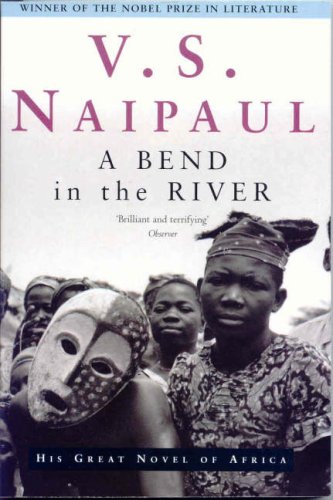
A Bend in the River


Title: A Bend in the River

Author: V.S. Naipaul

Number of pages: 336

Started: 14 May 2010

Finished: 21 May 2010

Opening words:

The world is what it is; men who are nothing, who allow themselves to become nothing, have no place in it.

Plot summary:

Salim, the narrator, is a young man from an Indian family of traders long resident on the coast of Central Africa. Salim has left the coast to make his way in the interior, there to take on a small trading shop of this and that, sundries, sold to the natives. The place is "a bend in the river"; it is Africa. The time is post-colonial, the time of Independence. The Europeans have withdrawn or been forced to withdraw and the scene is one of chaos, violent change, warring tribes, ignorance, isolation, poverty and a lack of preparation for the modern world they have entered, or partially assumed as a sort of decoration. It is a story of historical upheaval and social breakdown. Naipaul has fashioned a work of intense imaginative force. It is a haunting creation, rich with incident and human bafflement, played out in an immense detail of landscape rendered with a poignant brilliance.

What I thought:

This book had moments of brilliance and some really beautiful writing at times. But at other times, I found it dragged and didn’t really flow.

It was a decent enough read, and by a Nobel Prize Winner no less, but I found that the book didn’t consistently draw me in in the way that I hoped it would. But it was a well written and decently plotted book and there were pats of it that were to be savoured. But as a book as a whole, I found that it didn’t quite work for me.

Thursday, 13 May 2010

Fear the worst


Title: Fear the Worst

Author: Linwood Barclay

Number of pages: 368

Started: 7 April 2010

Finished: 13 April 2010

Opening words:

The morning of the day I lost her, my daughter asked me to scramble her some eggs. “Want bacon with it?" I shouted upstairs, where she was still getting ready for work.

To find out if she wants bacon and to read more here
Plot summary:

The worst day of Tim Blake's life started out with him making breakfast for his seventeen-year-old daughter Sydney. Syd was staying with him while she worked a summer job - even if he wasn't entirely sure what her job at the Just Inn Time motel actually was - and Tim hoped this quality father-daughter time would somehow help her deal with his divorce. When she didn't arrive home at her usual time, he thought she'd probably gone to the mall to hang with her friends. When she didn't answer her phone he began to worry. When she didn't come home at all, he began to panic. And when the people at the Just Inn Time said they had no Sydney Blake working at the motel and never had, he began to see his life going into freefall. If she hadn't been working at the Just Inn Time every day, what had she been doing? Something she couldn't - or wouldn't - tell her own father about? To find his daughter Tim doesn't need to simply track her down - he needs to know who she really was, and what could have made her step out of her own life without leaving a trace. Only one thing has him convinced the worst hasn't already happened: the fact that some very scary people seem just as eager as he is to find her. The question is: who's going to find her first?

What I thought:

This was a decent thriller. It was a fairly fast moving read, with a few twists that were possible to foresee, but mainly one that encouraged you to keep turning the pages. I don’t really tend to read crime novels anymore, but Linwood Barclay’s books are quite light reads and ones that are a decent distraction from some novels that are perhaps more hard work to plough through. It was also good to have a book that wasn’t entirely sewn up in some warm and fussy happy ending.

Thursday, 6 May 2010

Robinson Crusoe


Title: Robinson Crusoe

Author: Daniel Defoe

Number of pages: 252

Started: 29 April 2010

Finished: 6 May 2010

Opening words:

I was born in the year 1632, in the city of York, of a good family, though not of that country, my father being a foreigner of Bremen, who settled first at Hull. He got a good estate by merchandise, and leaving off his trade, lived afterwards at York, from whence he had married my mother, whose relations were named Robinson, a very good family in that country, and from whom I was called Robinson Kreutznaer; but, by the usual corruption of words in England, we are now called - nay we call ourselves and write our name - Crusoe; and so my companions always called me.

I had two elder brothers, one of whom was lieutenant-colonel to an English regiment of foot in Flanders, formerly commanded by the famous Colonel Lockhart, and was killed at the battle near Dunkirk against the Spaniards. What became of my second brother I never knew, any more than my father or mother knew what became of me.

Being the third son of the family and not bred to any trade, my head began to be filled very early with rambling thoughts. My father, who was very ancient, had given me a competent share of learning, as far as house-education and a country free school generally go, and designed me for the law; but I would be satisfied with nothing but going to sea; and my inclination to this led me so strongly against the will, nay, the commands of my father, and against all the entreaties and persuasions of my mother and other friends, that there seemed to be something fatal in that propensity of nature, tending directly to the life of misery which was to befall me.


Plot summary:

The sole survivor of a shipwreck, Robinson Crusoe is washed up on a desert island. In his journal he chronicles his daily battle to stay alive, as he conquers isolation, fashions shelter and clothes, first encounters another human being and fights off cannibals and mutineers. With Robinson Crusoe, Defoe wrote what is regarded as the first English novel, and created one of the most popular and enduring myths in literature. Written in an age of exploration and enterprise, it has been variously interpreted as an embodiment of British imperialist values, as a portrayal of ‘natural man’, or as a moral fable. But above all it is a brilliant narrative, depicting Crusoe’s transformation from terrified survivor to self-sufficient master of his island.

What I thought:

This was a strange, but enjoyable, book. It was not the most straightforward read and one that took a bit of time to get used to some of the language, but once I did I found that I enjoyed the tale. At times it went into more detail than was perhaps necessary to describe some of Crusoe’s life on his desert island, but the story warmed up as the tale unfolded.

It was an interesting take on the castaway story, and presumably one of the first, and strangely it did not ever really focus on the sense of being alone and how that affected Crusoe. It did bring in his reflections on life and God and other such things, which might not sit entirely well with some modern readers, including the rather imperialist role that he takes on ruling over all those he comes into contact with. But it’s a good read and given that it is thought to be one of the first novels, one that I am glad I have read.

Wednesday, 28 April 2010

The Wind Up Bird Chronicle


Title: The Wind Up Bird Chronicle

Author: Haruki Murakami

Number of pages: 608

Started: 11 April 2010

Finished: 28 April 2010

Opening words:

When the phone rang I was in the kitchen, boiling a potful of spaghetti and whistling along with an FM broadcast of the overture to Rossini's The Thieving Magpie, which has to be the perfect music for cooking pasta.

I wanted to ignore the phone, not only because the spaghetti was nearly done, but because Claudio Abbado was bringing the London Symphony to its musical climax.


Plot summary:

Bad things come in threes for Toru Okada. He loses his job, his cat disappears, and then his wife fails to return from work. His search for his wife (and his cat) introduces him to a bizarre collection of characters, including two psychic sisters, a possibly unbalanced teenager, an old soldier who witnessed the massacres on the Chinese mainland at the beginning of the Second World War, and a very shady politician.

What I thought:

This book was an interesting read. A book of two halves. If I were to say what I thought of it purely based on the first half, I would use a word like “brilliant”. It was really engrossing and engaging. A good story and told in a way that I really liked. But then there was the second half of the book and somehow those observations on it no longer seem to apply. I found the second half more of a mish mash of stories and occurrences and absurdities. I just didn’t get where the second half of the book was coming from and why it was taking so long to come to its conclusion.

So it was a strange read. A lot of Murakami’s books are odd (in a good way) and tell a good story be that through a narrator or a talking animal. But somewhere along the line I thought this book lost its way and it took a lot to make me see it through to the end. Having said that, I liked the closing pages. It was a well written and moving end to the book, but it didn’t half take a long time to get there.

Saturday, 10 April 2010

The Guernsey Literary and Potato Peel Pie Society


Title: The Guernsey Literary and Potato Peel Society

Author: Mary Anne Shaffer and Annie Burrows

Number of pages: 248

Started: 4 April 2010

Finished: 10 April 2010

Opening words:

8th January, 1946
Mr. Sidney Stark, Publisher
Stephens & Stark Ltd.
21 St. James's Place
London S.W.1
England

Dear Sidney,
Susan Scott is a wonder. We sold over forty copies of the book, which was very pleasant, but much more thrilling from my standpoint was the food. Susan managed to procure ration coupons for icing sugar and real eggs for the meringue. If all her literary luncheons are going to achieve these heights, I won't mind touring about the country. Do you suppose that a lavish bonus could spur her on to butter? Let's try it—you may deduct the money from my royalties.

Now for my grim news. You asked me how work on my new book is progressing. Sidney, it isn't.

English Foibles seemed so promising at first. After all, one should be able to write reams about the Society to Protest the Glorification of the English Bunny. I unearthed a photograph of the Vermin Exterminators' Trade Union, marching down an Oxford street with placards screaming "Down with Beatrix Potter!" But what is there to write about after a caption? Nothing, that's what.

I no longer want to write this book—my head and my heart just aren't in it. Dear as Izzy Bickerstaff is—and was—to me, I don't want to write anything else under that name. I don't want to be considered a light-hearted journalist anymore. I do acknowledge that making readers laugh—or at least chuckle—during the war was no mean feat, but I don't want to do it anymore. I can't seem to dredge up any sense of proportion or balance these days, and God knows one cannot write humor without them.
In the meantime, I am very happy Stephens & Stark is making money on Izzy Bickerstaff Goes to War. It relieves my conscience over the debacle of my Anne Bront biography.

My thanks for everything and love,
Juliet

P.S. I am reading the collected correspondence of Mrs. Montagu. Do you know what that dismal woman wrote to Jane Carlyle? "My dear little Jane, everybody is born with a vocation, and yours is to write charming little notes." I hope Jane spat on her.


Read more of the book here

See the publisher’s website of the book here including a video about the book.

Plot summary:

January 1946: writer Juliet Ashton receives a letter from a stranger, a founding member of the Guernsey Literary and Potato Peel Pie Society. And so begins a remarkable tale of the island of Guernsey during the German occupation, and of a society as extraordinary as its name.

What I thought:

I read this book while I was on holiday in Jersey because I like to read a book based where I am staying. I couldn’t find a book about Jersey so went for its neighbour Guernsey instead (which is probably not the done thing, as they are not the best of friends).

This book was enjoyable, but lacked depth. I never really felt that I truly cared about the characters or that they were always necessarily that believable as people. The style also changed at the end of the book and moved away from letters to a brief diary like conclusion, which perhaps was not the most appropriate way to finish it. That is perhaps overly critical though. It is a light read about a dark subject – the German Occupation of the Channel Islands - and it is an enjoyable read and there is always something intriguing about reading other people’s correspondence, or perhaps that is just me! It was also a book that touched on a number of issues that I learned about while I was in Jersey – the way people responded to the Occupation, how they were left to fend for themselves by the British government, how desperately they needed Red Cross food, but weren’t allowed to have it and so on. These things meant more to me when I read them in the book because I had found out about them during my trip to Jersey already.

It was a pleasant read, and good for a holiday or as a light take on life, but not one of the better books that I have read.

Sunday, 4 April 2010

After the Quake


Title: After the Quake

Author: Haruki Murakami

Number of pages: 132

Started: 31 March 2010

Finished: 4 April 2010

Opening words:

Five straight days she spent in front of the television, staring at crumbled banks and hospitals, whole blocks of stores in flames, severed rail lines and expressways. She never said a word. Sunk deep in the cushions of the sofa, her mouth clamped shut, she wouldn't answer when Komura spoke to her. She wouldn't shake her head or nod. Komura could not be sure the sound of his voice was even getting through to her.

Komura's wife came from way up north in Yamagata and, as far as he knew, she had no friends or relatives who could have been hurt in Kobe. Yet she stayed rooted in front of the television from morning to night. In his presence, at least, she ate nothing and drank nothing and never went to the toilet. Aside from an occasional flick of the remote control to change the channel, she hardly moved a muscle.


Read a longer excerpt here.

Plot summary:

The economy was booming. People had more money than they knew what to do with. And then, the earthquake struck. Komura's wife follows the TV reports from morning to night, without eating or sleeping. The same images appear again and again: flames, smoke, buildings turned to rubble, their inhabitants dead, cracks in the streets, derailments, crashes, collapsed expressways, crushed subways, fires everywhere. Pure hell. Suddenly, a city seems a fragile thing. And life too. Tomorrow anything could happen. For the characters in Murakami's latest short story collection, the Kobe earthquake is an echo from a past they buried long ago. Satsuki has spent 30 years hating one man: a lover who destroyed her chances of having children, and who now lives in Kobe. Did her desire for revenge cause the earthquake? Junpei's estranged parents also live in Kobe. Should he contact them? Miyake left his family in Kobe to make midnight bonfires on a beach hundreds of miles away. Four-year-old Sala has nightmares that the Eathquake man is trying to stuff her inside a little box. Katagiri returns home to find a giant frog in his apartment on a mission to save Tokyo from a massive worm burrowing under the Tokyo Security Trust Bank. "When he gets angry, he causes earthquakes" says Frog. "And right now he is very, very angry."

What I thought:

This was a short, but good, read. It was made up of a series of short stories that told the tales of different people affected by the Kobe earthquake. It was a well written and slightly quirky read that told an engaging story. I really like Murakami’s writing style and this book was one of rather shorter works and a nicely observed tale.